.jpg?width=50&height=50&name=Goalbound(59of77).jpg)
If you are an active adult or athlete in Portland, ME, choosing a physical therapist is not a decision to take lightly. Your goal is not just to feel better — it is to get back to running, playing, and competing at your best. Too many people in Southern Maine have gone through a course of physical therapy that eased their pain temporarily but never addressed why the injury happened in the first place.
If you have been down that road, you already know how frustrating it is to hit a plateau or reinjure yourself months later. Choosing the right provider means looking past the surface and asking specific questions about how care is delivered, who delivers it, and how progress is actually measured.
Why Generic PT Often Falls Short for Athletes
Many traditional clinics operate on a high-volume model built around seeing as many patients as possible within a given hour. For runners, soccer players, triathletes, and recreational athletes, this approach rarely gets to the root cause of an injury.
If your provider is not spending real, uninterrupted time with you, it is difficult for them to truly understand your movement patterns, your sport, or your goals. Here is what that often looks like in practice:
- Sharing your therapist's attention with two or three other patients at once
- Being handed off to aides or techs for large portions of your session
- Receiving generic exercise sheets instead of an individualized plan
- A focus on reducing pain rather than restoring full athletic capacity

Questions to Ask When Choosing Your Physical Therapist
Is It Truly One-on-One Care?
Ask directly whether every session is spent one-on-one with a licensed Doctor of Physical Therapy for the full appointment. Consistent, individualized attention allows your therapist to notice subtle changes in movement, adjust your program in real time, and build an accurate picture of your progress across multiple visits.
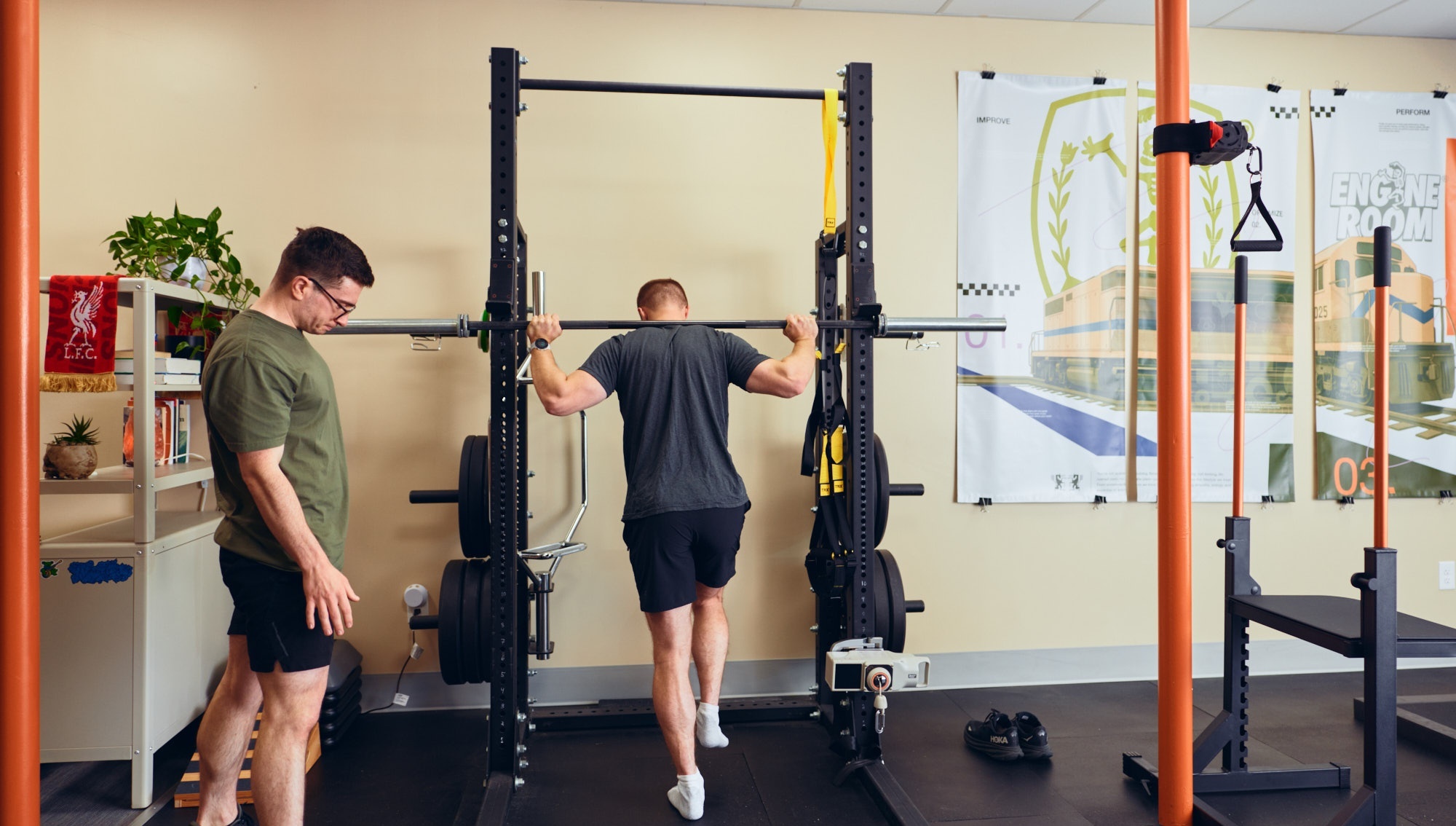
At Engine Room Performance Physical Therapy, every session is 60 minutes, one-on-one, with a Doctor of Physical Therapy. There are no aides and no handoffs.
What Are Their Credentials and Areas of Focus?
A Doctor of Physical Therapy degree is the baseline, but advanced training separates good clinicians from exceptional ones. Fellowship training represents one of the highest levels of clinical education in orthopedic and manual therapy, held by only a small number of physical therapists in Maine.
Ask whether your provider has pursued this level of postgraduate education. It directly translates to more advanced clinical reasoning and hands-on skill — both of which matter when you are navigating ACL rehab, post-op rehab, or a complex overuse injury.
How Do They Measure Progress and Readiness to Return to Sport?
Subjective reports of feeling better are not enough when your goal is a safe return to competitive activity. Ask whether the clinic uses objective testing tools such as force plate testing, isokinetic or dynamometer testing, and functional movement assessments to quantify strength, power, and side-to-side asymmetries.
For runners specifically, ask whether the clinic offers a dedicated running gait analysis rather than a general observational walkthrough. Objective data removes guesswork and gives both you and your therapist a clear benchmark for progress.
Is the Approach Focused on Performance, Not Just Pain?
Find out whether the clinic's model is built to take you beyond symptom relief. Ask how they structure care from your first visit through your return to full activity, and whether there is a defined process for progressing you back to sport with measurable milestones along the way.
This is especially important for athletes managing knee pain, hip pain, or low back pain — conditions that can feel resolved on the surface while underlying movement deficits remain.
What This Looks Like at Engine Room Performance Physical Therapy
Engine Room Performance Physical Therapy was built around the questions above. Every session is a full 60 minutes, one-on-one, with a Fellowship-trained Doctor of Physical Therapy — a distinction held by only a handful of physical therapists in Maine.
Care at Engine Room is grounded in objective, data-driven testing. Force plate testing and isokinetic dynamometer assessments are used to identify the actual root cause of your pain or performance limitation rather than relying on guesswork. For runners, dedicated running gait analysis and running form assessments help identify mechanical issues before they become injuries.
The Return-to-Sport Testing process uses structured, objective progression milestones so you and your therapist both know exactly when you are ready to compete again. This is especially critical for athletes recovering from ACL injuries, meniscus injuries, or any post-op rehab following lower extremity surgery.
Care follows a clear three-phase model:
- Improve — Address pain, restore mobility, and calm irritated tissue
- Optimize — Rebuild strength, movement quality, and neuromuscular control
- Perform — Progress through sport-specific training and return-to-sport testing
This model applies whether you are a soccer PT patient working back from a hamstring strain, a runner managing IT band syndrome, or an athlete recovering from hip impingement. Because Maine is a Direct Access state, you do not need a physician referral to begin care.
Take the Next Step Toward Real Performance Recovery
Choosing the right sports physical therapy provider in Portland, ME comes down to one thing: finding a clinician who treats the root cause, not just the symptom, and who is committed to getting you back to full performance.
If you are tired of generic care that has not resolved your injury, Engine Room Performance Physical Therapy is ready to help you take a different path. Learn more about what we offer on our Services page, or get to know our team on our About page. When you are ready, visit Engine Room Performance Physical Therapy to schedule a free 15-minute discovery call with no pressure and no commitment.

Comments